

Bitcoin rose +2% to $65,800 on Monday, June 15, after the US and Iran confirmed a memorandum of understanding to end their war – a deal that includes an immediate halt to hostilities and a commitment to reopen the Strait of Hormuz within 30 days.
The announcement triggered a broad risk-on rotation: S&P 500 futures rose +1.20% in Asian trade, Brent crude dropped -4.51% to $83.39 amid relief over Hormuz supply, and altcoins, including XRP, Solana, and Cardano, gained between +3% and +4% in the same session.
Spot Bitcoin exchange-traded fund outflows, reported by SoSoValue, cooled to $315.8M last week from $1Bn-plus in each of the prior four weeks – a deceleration that provided modest structural support but did not reverse the net selling trend.
The analytical question is no longer whether the US–Iran peace deal constitutes a genuine geopolitical catalyst; it is whether the transmission from geopolitical relief into durable BTC price recovery can sustain while ETF flows remain net negative, and the Crypto Fear & Greed Index sits at 20/100, deep in Extreme Fear territory.
$BTC pumps into a new week.
Bitcoin immediately broke the previous weekly high and previous daily high.
In terms of probabilities, this means there is a higher probability of holding the 60.8K PWL this week.
The best RR POI for longs this week is the one closest to the PWL,… pic.twitter.com/JrTCc04B7K
— Lennaert Snyder (@LennaertSnyder) June 15, 2026
Cross-Asset Transmission: How the Hormuz Reopening Flows Into Crypto Risk Appetite
The transmission mechanism linking energy prices to inflation expectations and risk asset positioning is more complex than it seems. The MOU’s 30-day Hormuz reopening removes the supply-shock premium that kept Brent crude high, exemplified by Monday’s 4.51% decline.
Falling energy prices lower near-term inflation expectations, reducing the likelihood of further Fed tightening and raising the discount rate for long-duration assets like Bitcoin.
ETF flows paint a mixed picture; there were $315.8M in net outflows for the week ending June 13, far less than the previous week but still negative.
This deceleration suggests aggressive institutional deleveraging may be easing. However, ongoing outflows indicate a structural demand challenge that a single geopolitical catalyst is unlikely to change quickly. Monday’s price action reflects relief rather than a return to strong institutional investment.
DISCOVER: Best Meme Coins to Buy in 2026
Bitcoin at $65,800: Relief Bounce or Structural Recovery in Progress?
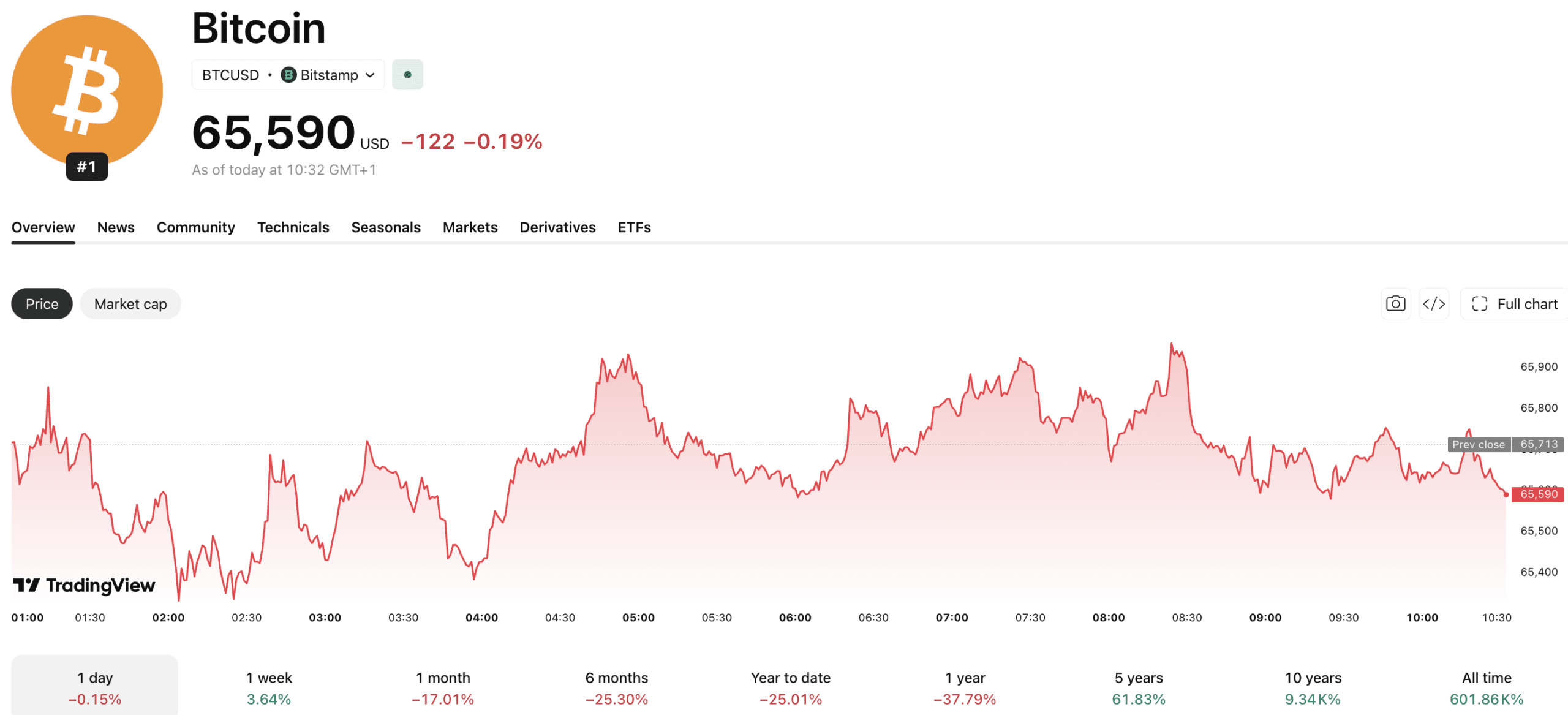
Bitcoin’s recovery from its June 5 annual low near $59,100 – a level not seen since October 2024 – has now covered approximately $6,700 over ten sessions, with Monday’s print at $65,809 representing the strongest close in that window. The structure of the move matters: earlier Iran-related rallies pushed BTC to a 12-week high near $79,500 in late April.
This move came before a sharp fade, and analysts tracking the bounce flagged the 50% Fibonacci retracement from the January high to the February low at $78,962 and the 200-day exponential moving average near $81,708 as meaningful overhead resistance. Those levels remain intact and distant from the current price, indicating that Monday’s move is well within the lower half of the established corrective range.
At $65,809, Bitcoin sits in a zone that offered congestion on the way down – the $62,000–$66,000 band absorbed selling pressure through late May before the final leg to annual lows. The current bid needs to establish a daily close above $66,440, the session high recorded in some venues, to confirm that the band is now functioning as support rather than overhead supply.
The prior Iran-strike selloff that drove BTC through $73,000 created a multi-level resistance structure on the way back up, and the current recovery has not yet tested the more consequential levels above $68,000. The +2% session gain is consistent with a short-covering bounce and positioning relief rather than a technically confirmed breakout – a distinction the price structure at this range makes explicit.
DISCOVER: Best Meme Coins to Buy for June
Disclaimer: Coinspeaker is committed to providing unbiased and transparent reporting. This article aims to deliver accurate and timely information but should not be taken as financial or investment advice. Since market conditions can change rapidly, we encourage you to verify information on your own and consult with a professional before making any decisions based on this content.

Daniel Frances is a technical writer and Web3 educator specializing in macroeconomics and DeFi mechanics. A crypto native since 2017, Daniel leverages his background in on-chain analytics to author evidence-based reports and deep-dive guides. He holds certifications from The Blockchain Council, and is dedicated to providing “information gain” that cuts through market hype to find real-world blockchain utility.